Connect your systems, harmonize your information, and enrich them with 3rd party insights to create one Unified Data Model for Procurement that your analytics and AI agents can rely on. While other AI pilots stall on shaky data, you scale them on a solid foundation.

Every AI agent in procurement needs to make decisions based on data: which supplier to invite, which contract to apply, which category to assign a request or invoice to. But procurement data sits in multiple ERPs and eProcurement suites, lacks a consistent ontology, and receives little attention unless an analysis is needed. Put AI on top and it scales the inconsistency. Fix the foundation and every use case gets better.
Fragmented source
systems.
Multiple ERPs, eProcurement systems, data providers, and spreadsheets. Data is scattered, duplicated, and incomplete.
No common language.
Different category structures across systmes, inconsistent spend classification, missing supplier mappings. Without a common data model, every analysis is a (data) science project.
Inconsistent truths.
Spend analytics, opportunity detection, and automation rest on partial information and data nobody fully trusts.
Your data foundation shouldn't wait for your ERP migration. Connect SAP ECC, SAP S/4HANA, Oracle Fusion, Microsoft Dynamics, SAP Ariba, Coupa, Ivalua, or Jaggaer with pre-configured connectors and transformers, or start with a simple Excel or CSV upload. Extract data from every source without replacing your existing infrastructure.

Data structures built for accounting don't answer procurement questions. Centralize structured and unstructured data from all sources in our Data Store and create one unified data model built for Procurement. Increase master data consistency across systems while your data stays in your infrastructure, under the governance of your IT department.

Classification shouldn't be a once-a-year project. Build your category taxonomy with our taxonomy builder and classify and reclassify transactions, invoices, and expenses against it. Benefit from continuous classification optimization so spend analytics, opportunity detection, and AI agents speak the same language as your category managers.

Stop letting duplicate records undermine every spend analysis. Extract, harmonize, de-duplicate, and cleanse data across all your connected systems, and consolidate supplier records into one harmonized profile with full transparency on parent-child relationships. Create one reliable supplier record, everywhere it matters.

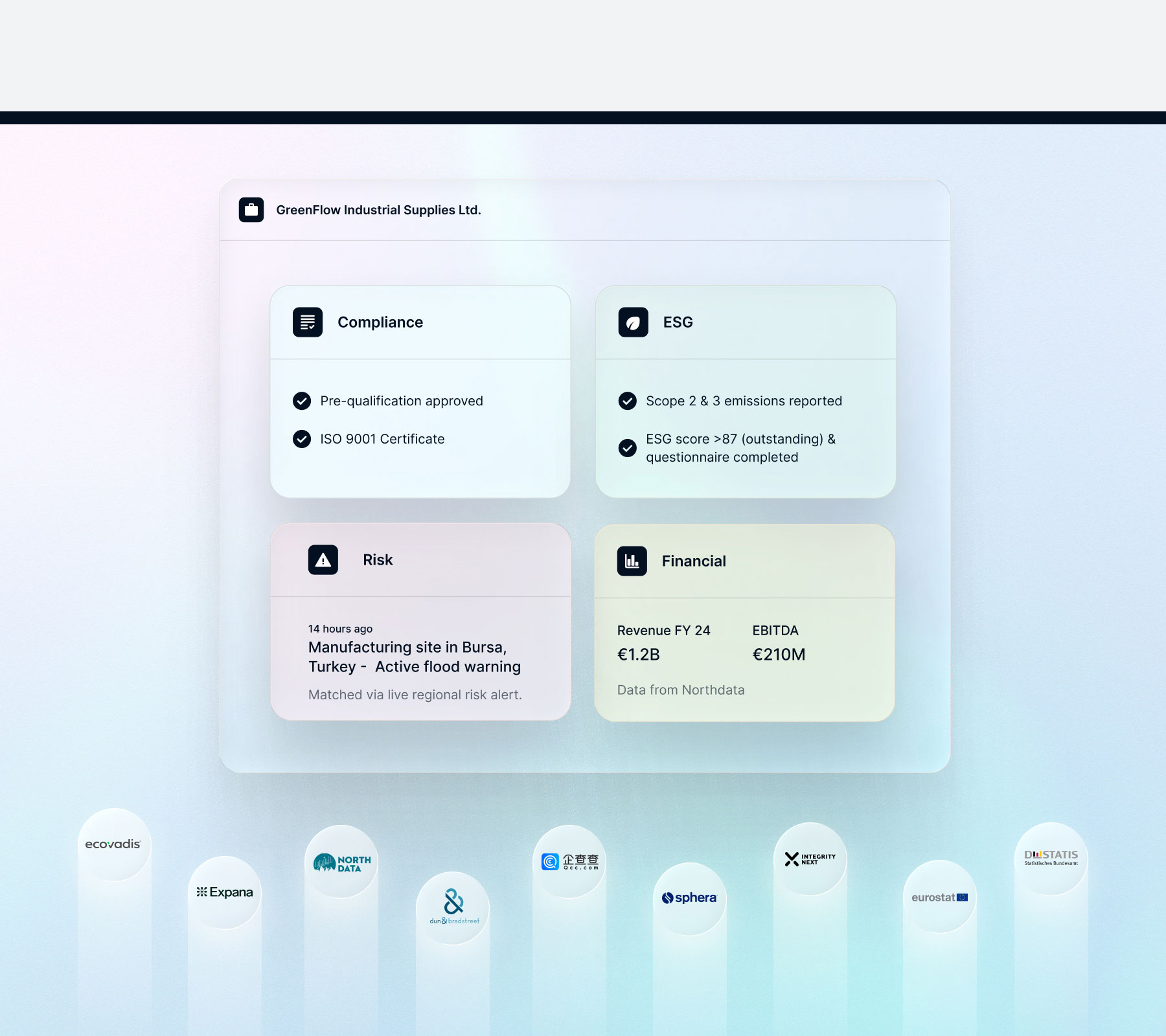
Internal data tells you what you bought, not if it was the right decision. Enrich your records with 3rd party category intelligence, supplier scores, and financial, risk, or ESG data from providers like North Data, EcoVadis, Dun & Bradstreet, RapidRatings, CDQ, Eurostat, or Destatis. Turn internal data into a decision-support engine for categories, markets, and suppliers.

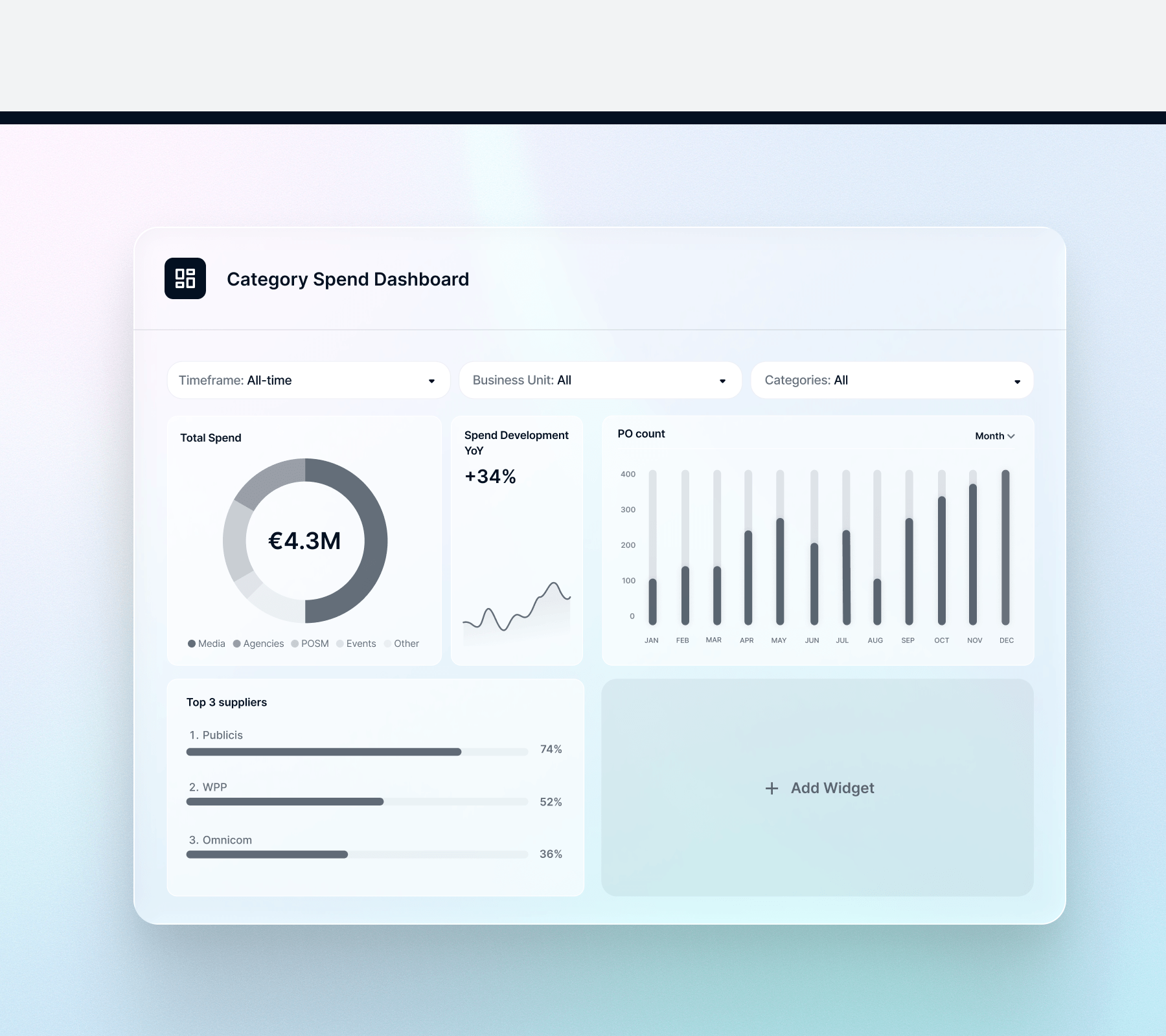
Your data foundation is just the beginning. Explore your data in detail with our AI-powered Universal Search and no-code analytics. Let 40+ AI agents act on your insights across intake, sourcing, supplier management, and purchasing operations. With Human in the Loop controls and a tamper- proof audit log, our Procurement Automation Platform helps you orchestrate the Source-to-Pay process on data you can trust.

Gain a consistent, reliable foundation for data-based decisions with one unified data model and continuous classification optimization.
Let AI agents classify, route, source, and negotiate on harmonized data, with every action explainable and traceable.
Democratize data analytics across your team with Universal Search and no-code and low-code analytics tools.
Keep your data in your infrastructure, protected by AES-256 encryption and fine-grained access rights.

6 steps to improve your data quality with AI Poor data quality impacts savings and performance. Explore 6 AI-driven steps to boost procurement data quality and results.
Blog
015
Building a procurement data strategyLearn how to build a procurement data strategy to improve data quality, spend analysis, drive smarter decisions, and maximize procurement impact.
Blog
017
Solving Procurement’s data quality challenge with AI and advanced analyticsProcurement data management is critical for success. Learn how AI fixes poor data quality and helps procurement teams make better decisions.
Blog
008
Reliable AI automation requires structured spend data, supplier master data, contract data, and a consistent category taxonomy. Procure Ai's Unified Data Platform connects to existing ERP and eProcurement systems, harmonizes transactional data, removes duplicates, and classifies spend to create the foundation that makes agentic automation accurate and auditable.
A baseline of structured data, documented processes, and at least partial digitization is sufficient to start. Procure Ai is designed to work within complex, multi-system environments and can be deployed modularly — organizations do not need a finished eProcurement implementation or S4 transformation before capturing value. Clean data and defined governance boundaries matter more than maturity stage as Procure Ai is deployed alongside other technology platforms.
Yes. Besides connecting your ERP and other source systems for live spend visualization, you can
also upload your spend data as an Excel or CSV file. This enables data harmonization,
visualization, and deeper analytics.
Procure Ai integrates with ERP systems from SAP ECC 6.0 to S/4HANA, Oracle Fusion, or Microsoft Dynamics, and with eProcurement systems like SAP Ariba, Ivalua, Jaggaer, or Coupa. For
supplier data enrichment and risk management, integrations with North Data, CDQ, EcoVadis, Dun & Bradstreet, RapidRatings, and Darkbeam are available.
Unified Data Platform connects to available ERP and eProcurement systems to retrieve transactional data, harmonizes it, removes duplicates, and classifies spend under a consistent taxonomy to enable spend and data analytics.
Consistent classification of transactional data ensures accurate spend analytics, opportunity identification, and reliable process automation.