Tail spend optimization: From liability to value

Francesco Peroni
Chief Revenue Officer Procure Ai, Sales & GTM leader.
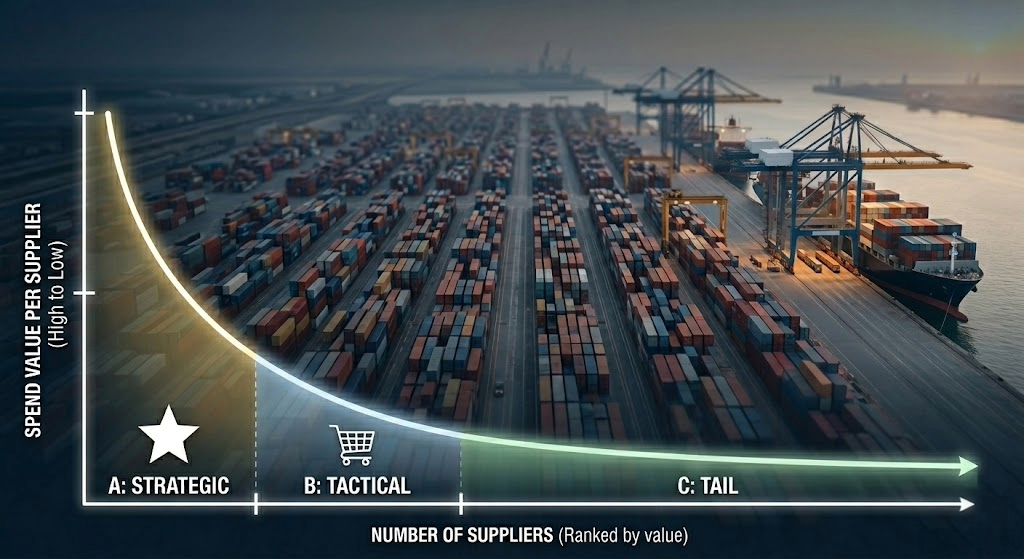
Optimizing tail spend helps create savings and process efficiencies in high-volume, low-value transactions in Procurement. Increased competition and automated processes create cost savings through autonomous negotiations and simplified supplier onboarding.
Tail spend management is one of procurement's most persistent challenges, and one of its biggest untapped opportunities. It accounts for just 20% of total spend, but up to 80% of all transactions. While every organization knows that there is value in managing these transactions, most have come to terms with the fact that throwing resources at it won’t win them business recognition or prizes.
The logic seems sound: the individual transaction values are too low to justify procurement involvement. But zoom out, and the picture changes fast. According to BCG, actively managing tail spend can reduce annual expenditure by 5–10%. For a business with €500 million in tail spend, that's up to €50 million sitting on the table.
In this blog, we unpack how to optimize tail spend management in practice, why common approaches only go so far, and how a connected platform can turn it from a persistent liability into a source of real value.
Tail spend refers to the high volume of low-value transactions that sit below your procurement engagement thresholds. Depending on your organization, country, and team size, those thresholds can range anywhere from €2,500 to €250,000.
The transactions in the tail themselves are individually small. But collectively, they create a significant and underappreciated set of problems. To understand why, it helps to look at what a typical tail spend transaction involves.
Picture a typical tail spend transaction. A stakeholder needs something - software, a specialist service, a one-off piece of equipment. The value is €5,000. It falls below the threshold for formal procurement involvement, so the stakeholder sources it themselves without involving Procurement.
They approach a vendor they already know, or one that approached them in the past. The proposal comes back and looks reasonable. If company policy requires three quotes, two more suppliers get a quick email, but the decision has already been made. The information shared with each supplier is inconsistent. There's no real competition.
The vendor is new, so a free-text purchase request is submitted to procurement. Back-and-forth emails follow to clarify exactly what's being bought, for whom, and why. The new vendor then needs to be onboarded, triggering data collection, risk and compliance checks, and approval workflows. This takes weeks. The stakeholder, frustrated by the delay, starts discussing the scope with the supplier informally. Work begins before the purchase order is issued, introducing risks and undermining processes. This is called maverick spend.
Meanwhile, procurement is trying to reduce the number of suppliers and consolidate spend with preferred vendors. Approving a new supplier for a €5000 transaction runs counter to that KPI, so procurement pushes back or declines the onboarding entirely. The stakeholder feels blocked. Procurement gets the blame. The relationship takes a hit.
Multiply this across hundreds or thousands of transactions a year, and the scale of the problem becomes clear. And it creates three distinct issues that compound each other.
The story above illustrates three procurement challenges that recur across virtually every tail spend transaction:
Together, they result in unmanaged tail spend, which drives three compounding costs.
These three problems and costs are interconnected. You can't fully solve any one of them without addressing the others, which is why approaches that tackle only part of the picture tend to fall short.
Managing tail spend is not a new challenge, and most organizations have tried a range of approaches over the years. Common solutions include:
What each of these approaches lacks is connection. Tail spend isn’t a single problem with a single fix — it’s a system of interconnected issues that needs a system of interconnected solutions. The right approach depends on your organization’s size, category complexity, and maturity, which is why the most effective strategies combine multiple tools and methods rather than relying on any single one.
Getting tail spend under control requires addressing several distinct challenges at once. Organizations that make meaningful progress typically have the following capabilities in place.
You can’t manage what you can’t measure. Tail spend is genuinely hard to see - transactions happen across departments, geographies, and systems, and many never hit a formal procurement tool at all. Consolidating and cleansing spend data from across the organisation is the foundation of any tail spend strategy. Without it, the problems and the opportunities will continue to hide in plain sight.
Category strategies need to be embedded into day-to-day purchasing behavior, not stored in documents. This means having a mechanism to define strategies and push them actively into sourcing decisions, supplier selection, and intake guidance - so that the strategy is followed even when no category manager is in the room.
Intake is where tail spend is either captured or created. Guiding stakeholders toward existing buying channels, preferred suppliers, and active contracts - before a new vendor request is raised - prevents unnecessary spend from entering the tail in the first place. Structured data capture at the point of request eliminates the clarification cycles that drive process cost.
Tail spend transactions are individually too small to justify a category manager running tactical sourcing events or spot buys for each one. Bringing real competition to these transactions requires sourcing processes that can be automated or guided - ensuring information is shared fairly, the process is completed efficiently, and results are documented - without demanding significant manual effort per event.
Beyond sourcing, there is often further savings potential in negotiating directly with suppliers - whether on an inbound proposal or following a tactical sourcing event. At tail spend scale, this is only viable if negotiation can happen without requiring human involvement in every interaction.
Supplier onboarding friction is one of the primary drivers of maverick spend. Streamlining onboarding - so that compliance checks are completed efficiently, and new vendors can be activated without weeks of delay - removes a key reason stakeholders bypass procurement. Equally important is keeping the supplier base clean through consistent offboarding and consolidation, and tracking spend with diverse or sustainable suppliers for organizations with ESG commitments (most diverse suppliers sit in the tail).
The process cost of unmanaged tail spend requisitions is driven largely by the manual handling of free-text requests, clarification loops, approvals, and exceptions. Automating the transactional layer - from purchase requisition through to invoicing - based on category- and threshold-specific rules eliminates this overhead at scale, while flagging genuine exceptions for human review.
Most organizations that try to address tail spend end up with a patchwork of tools that don't talk to each other: spend data in one system, tactical sourcing and negotiations in another (if at all), supplier management in a third, and P2P in yet another. The result mirrors the problem itself - fragmented, inefficient, and hard to manage.
Procure Ai is purpose-built to be different. Each module targets one of the core capabilities outlined above, and because they share a single data layer and workflow engine, strategy flows automatically into execution and operationalization across every transaction.
Unified Analytics brings together spend data from across the organization, cleanses and categorizes it, and gives procurement a clear picture of where tail spend is concentrated. Which categories have the highest proportion of fragmented transactions? Where is automation most likely to deliver impact? Where are hidden tail spend opportunities sitting within existing supplier relationships? This is the foundation for everything else.
Category strategies are only as good as their execution. The Category Management module allows procurement teams to define category strategies directly within the platform and push them across every other module so strategies don’t just live in documents, but actively shape purchasing behavior, sourcing decisions, and supplier selection in day-to-day operations.
Generative Intake Management guides stakeholders toward existing buying channels, preferred suppliers, and active contracts before a new vendor request is ever raised. Structured data capture replaces free-text requests, eliminating the clarification cycles that consume so much process time. For stakeholders, it feels like a faster path to getting what they need. For procurement, it means higher policy compliance, more spend under management, less noise, and fewer situations where the only answer is to push back.
Where multiple bids are required, Autonomous Sourcing makes competition real and scalable. Tactical sourcing events and spot buys can be automated, or stakeholders can be guided through the process, ensuring information is distributed fairly, the process is completed efficiently, and results are documented. This addresses the savings problem directly, without requiring a category manager to run events manually.
Autonomous Negotiations extend the savings opportunity further. Whether working from a stakeholder-sourced proposal or as an extension of an autonomous sourcing event, AI-driven negotiation engages suppliers, works toward better commercial terms, and captures savings from spend that would previously have gone untouched.
Effective supplier onboarding - triggered from intake or following a negotiation - means new vendors are processed efficiently, compliance checks are completed, and the process moves forward without the delays that often push stakeholders toward maverick behavior. Offboarding can be managed too, keeping your supplier base clean and your consolidation KPIs on track. For organizations with ESG or supplier diversity goals, this is also where spend with certified diverse or sustainable suppliers becomes visible and trackable (in combination with Analytics).
Workflow automation addresses the process cost problem at its core. It starts with free-text structuring, converting unstructured purchase requests into clean, usable data that doesn't require manual interpretation. From there, category and threshold-specific rules determine how each transaction is handled, automating the following processes based on your organization's risk appetite:
When all three problems are addressed together, the results go beyond incremental improvement. Key benefits include:
Tail spend doesn't have to be the problem you manage by ignoring it. With the right platform in place, it can be turned from an issue into a genuine source of value - in savings captured, process time recovered, risk reduced, and a procurement function that stakeholders want to work with rather than around.
Stop sweeping your tail spend under the carpet and start creating value from it now. The technology is ready. Are you? Get in touch to see how Procure Ai can help.
New partnership supports Austrian Procurement teams to identify, implement, and scale AI use cases
News
046
Sourcing Connections helps procurement teams across the Middle East work, source, and deliver value with AI automation.
News
045
Intake & Orchestration are the hottest Procuretech category right now; orchestration is the enabler for multi-agent systems to deliver on their promise. Learn what it is and how it works.
Webinar
044
What skills will define the future of procurement? While AI is reshaping procurement roles, we explore why human expertise remains critical and how to build AI-ready procurement teams.
Webinar
Blog
043