AI in Strategic Sourcing

Konstantin von Büren
Co-Founder Procure Ai

AI enables Procurement to execute strategic sourcing faster, more consistently, and at greater scale by automating manual execution while supporting better commercial decisions. Rather than replacing sourcing professionals, AI eliminates administrative work, expands execution capacity, and enables better sourcing outcomes through AI-powered analysis and optimization.
Inflation, geopolitical instability, volatile supply markets, and fragmented supplier ecosystems are forcing organizations to expect far more from their sourcing teams than cost savings. Risk, resilience, sustainability, and innovation are shaping decisions alongside commercial considerations.
These expanding expectations compound a challenge that has always existed in strategic sourcing: complexity. Multiple suppliers, competing evaluation criteria, and layered business constraints have always made award decisions difficult. But spreadsheet-based analysis quickly reaches its limits when you also must consider price indices, tariffs, sustainability, supply chain risk, and supplier diversity.
This is why the focus in sourcing is shifting from process efficiency to decision intelligence. And it is why AI is moving to the center of how leading organizations approach strategic sourcing.
In this blog, we look at how the sourcing technology landscape is structured, how sourcing optimization enables decision intelligence, how AI is changing what is possible, and what Procure Ai is doing differently.
Sourcing demands vary widely across an organization, and not every transaction requires the same approach. Generally, sourcing falls into three categories based on spend value, complexity, and the level of procurement involvement required.
The 2026 Gartner Market Guide for Sourcing Applications identifies three sourcing technology categories, each supporting different levels of sourcing requirements and maturity.
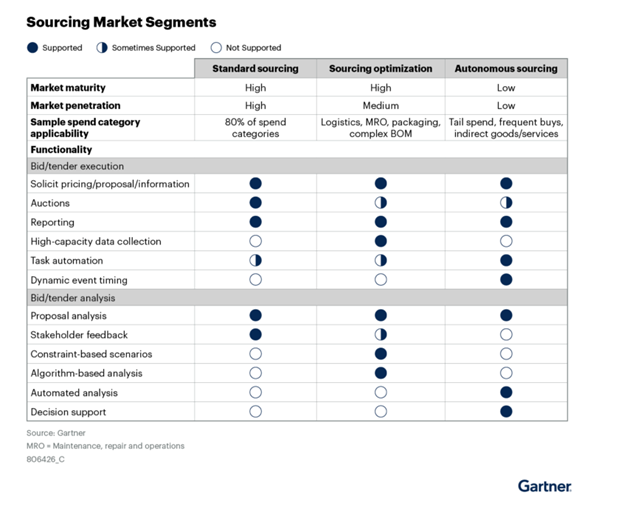
Each category has different maturity levels, adoption rates, and spend applicability, but the lines between them are blurring as AI becomes commonplace across the landscape. In practice, organizations need capabilities from across this full spectrum to handle the range of sourcing demands they face. But most sourcing vendors do not offer this breadth.
A recent The Hackett Group series on sourcing automation found that about 78% of organizations have the basic technology for (strategic) sourcing in place, yet only 23% use AI features: a story of immense untapped potential.
Especially, Autonomous Sourcing is a challenge for many, as it is more of a buying channel in tail spend management that gets triggered during the purchasing process than a full-on sourcing capability. See our blog, Autonomous Sourcing in Procurement, for a full exploration.
Procure Ai is a sample vendor in the 2026 Gartner Market Guide for Sourcing Applications. And with immense pride, we can say that we are the only vendor in the Market Guide cited by Gartner for delivering sourcing optimization, autonomous sourcing, and autonomous negotiation capabilities on a single platform alongside wider procurement automation capabilities, like Intake and orchestration, or supplier management.
Strategic sourcing is the end-to-end process of identifying needs, defining requirements, structuring sourcing events, soliciting and evaluating bids, negotiating terms, and making award decisions for high-value, high-complexity spend.
What distinguishes it from tactical or transactional sourcing is the depth of evaluation, the number of variables involved, and the business impact of the decision. It is also distinct from Category Management, which focuses on the broader strategic direction of a spend category, including market analysis, supplier relationship development, and long-term planning.
Complexity in strategic sourcing arises from the volume and variety of information involved: supplier bids across large sets of items with cost breakdowns, secondary information like capacity limitations and alternative offers, and business constraints such as switching costs, risk profiles, and performance history.
Even moderately sized events involve significant complexity. An event with 10 items and five suppliers can be awarded in nearly 10 million ways on price alone (510). Add non-price criteria, and the possible outcomes grow exponentially. While many requisitions are straightforward and low value, the bulk of organizational spend is managed in events that would benefit from more rigorous evaluation than they currently receive.
Given that most sourcing events consider more than just price when making award decisions, we can consider the majority of sourcing events as at least moderately complex. But many organizations still struggle to use information beyond price in a structured, methodical way when making sourcing decisions.
Making award decisions without a holistic analysis is a missed opportunity on two fronts:
1. Stakeholder relationships: where transparency around decision-making increases engagement and trust, making isolated, price-focused award decisions undermines Procurement’s ability to position itself as a strategic function.
2. Supplier relationships: where discussions and negotiations are focused on commercial factors without appropriate context, instead of engaging in more nuanced and qualitative discussions, trust in strategic relationship building and partnering erodes.
And while sourcing event management and analysis can benefit from innovations in automation, real value is created where human decision-making gets augmented with the tools and data that help category managers navigate complexity with confidence.
The use of linear mathematical optimization to calculate the optimal award allocation under consideration of given business rules and constraints is what is considered sourcing optimization. The market refers to this capability by several names. Gartner uses both "sourcing optimization" and "advanced sourcing optimization" to describe this category, and vendors and analysts sometimes shorten it to "advanced sourcing" or “complex sourcing.” And while this technology has been around for over 15 years, many organizations are still blissfully unaware and struggle with implementing standard sourcing effectively.
The main goal of sourcing optimization is to identify the best supplier award and selection decisions that balance commercial factors, business rules, preferences, and constraints such as capacity, performance, risk, sustainability, or diversity. Each combination of these factors represents a possible sourcing scenario, which can be modeled and updated flexibly in real time as constraints, requirements, or preferences evolve. The ability to quickly adjust scenarios and test new assumptions is what gives sourcing optimization its practical advantage over Excel-based analysis.
This practice of modeling and comparing different award strategies against real-world constraints is known as scenario-based thinking. The concept originated in military strategic planning in the 1990s as a method for modeling options and their resource implications, and it translates directly into procurement trade-off decisions.
Common scenarios include:
An optimal decision is reached when all relevant items can be allocated to one or more suppliers, considering the specified business rules, preferences, and external constraints. The cost of this solution is likely not the lowest, but it offers the best overall value for the business.
Because trade-offs are modeled and quantified rather than assumed, procurement gains visibility into the real cost of every decision. For example, if the optimal allocation requires four suppliers, but a business rule limits it to three, sourcing optimization quantifies exactly what that constraint, the elimination of one additional supplier, costs.
This kind of opportunity cost analysis enables procurement to have data-backed discussions with internal stakeholders and external suppliers, grounding negotiations in facts rather than assumptions. Combined with the ability to update scenarios in seconds rather than hours, this speed and transparency strengthen both stakeholder engagement and supplier relationships, and position procurement as a strategic business partner instead of a price-focused function.
In a market environment where conditions shift quickly (think oil prices, tariffs, blocked sea passages), the ability to rapidly model different options and understand their (monetary) implications is becoming a competitive differentiator. Speed without structured decision-making leads to poor (meaning: expensive) outcomes. Scenario-based thinking provides the framework for moving fast without cutting corners.
Sourcing optimization platforms bring a set of capabilities that go well beyond what standard sourcing tools offer.
Critically, these capabilities make decisions holistic, repeatable, and independent of the individual sourcing manager running the analysis. This ensures decisions are consistent and compliant, and the outcome is driven by the data and the model, not by who happens to be running the event.
Sourcing optimization has been around for over 15 years, but adoption has been held back because the tools were too difficult to use, too slow to set up, and too expensive for widespread deployment. AI removes those barriers and allows organizations to unlock value across a much wider share of sourcing events and business spend.
Generative AI is accelerating the creation and management of sourcing events. RFx documents can be drafted, questionnaires generated, and bid sheets configured through natural language in a fraction of the time it previously took. This improves speed, but it does not, on its own, improve the quality of award decisions.
Agentic AI goes a step further. Rather than simply analyzing data or recommending actions, agents execute defined tasks within the sourcing workflow: managing bidding rounds, chasing supplier responses, validating submissions, generating scenario comparisons, delivering feedback between rounds, preparing negotiation inputs, and drafting award recommendations. All within guardrails configured by the procurement team.
Analytical AI is where outcomes start to change. It validates bid data, detects outliers and errors, benchmarks prices against market data, and summarizes complex supplier proposals into decision-ready insight. What previously took two weeks of manual spreadsheet analysis can now happen within hours of data upload, automatically surfacing negotiation opportunities and anomalies that manual review would miss. These insights also strengthen the quality of feedback provided to suppliers between rounds, making each iteration more targeted and effective.
Natural language interfaces and guided workflows mean buyers can now describe constraints in plain language and have the optimization engine automatically generate scenarios. Speak after me: I want to see the ideal award allocation using at most 3 suppliers per region, with at least two of them being incumbents, no supplier receiving more than 40% of the total value, and at most 2 new suppliers. ESG score must be above 80 and risk scores below 15.” Working on it.
The ability to describe desired outcomes rather than individual rules expands the reach of sourcing optimization beyond specialist users and the top tier of complex tenders into everyday (strategic) sourcing events completed by category managers. The technology that was once reserved for specialists becomes practical for any buyer running any competitive event. The result is not that AI replaces human judgment in complex sourcing decisions. Instead, it enhances its reach and augments decisions by giving buyers the ability to see all their options, understand the cost of every trade-off, and make holistic decisions they can defend.
Intelligent negotiation is a rapidly emerging segment within the sourcing market. Capabilities range from creating negotiation briefings based on supplier profiles and proposals, recommending negotiation strategies and designs (auctions, game theoretic sequencing) based on proposals, historical data, and market conditions, to fully automating negotiations for low value tail spend purchases.
AI-driven negotiation extends the value captured from a sourcing event by engaging suppliers on commercial terms after bid evaluation, whether as part of a structured sourcing process or as a standalone interaction. For tail spend and tactical categories, where individual transaction values are too low to justify manual negotiation, autonomous negotiation can capture an average 4.9% savings from spend that would otherwise go entirely untouched.
Agents are increasingly playing a role in negotiations too, from suggesting negotiation formats, preparing negotiation briefings, guiding buyers on tactics, to handling communication during live events. The result is that procurement teams can run more negotiations, more consistently, without scaling headcount.
Traditionally, strategic sourcing has been rather reactive. A need arises, an event is launched, and a supplier is selected. AI enables a shift toward proactive sourcing, where opportunities are identified through data analysis or changing market conditions before a formal request is raised. This is still an emerging capability, but it represents the direction of travel for organizations investing in sourcing intelligence.
Across all of these areas, the underlying principle is the same. Agents handle bounded, well-defined work reliably, while humans remain in charge of strategic decisions such as award choices, supplier selection, and managing commercial trade-offs. As AI matures, this collaboration between human judgment and agentic execution will deepen. Gartner expects collaborative agents capable of coordinating across multiple tasks within the sourcing workflow to emerge within the next six to twelve months.
Organizations looking for strategic sourcing optimization tools face a familiar trade-off. Specialist tools offer best-in-class depth in scenario modeling and bid analysis, but they sit in a silo, disconnected from the wider procurement stack (no, jumping off from a Performance Management Solution is not an integration).
Suite modules offer integrated data and workflows on standard sourcing capabilities, but their optimization capabilities are typically less embedded and extremely hard to use (do you want to learn a custom language to perform Sourcing Optimization?).
Procure Ai resolves that trade-off by delivering specialist-grade depth and automation with a focus on usability and decision-making while staying connected to the wider procurement process by design. This is one of the main reasons why Procure Ai is a sample vendor in the 2026 Gartner Market Guide for Sourcing Applications for both autonomous sourcing and sourcing optimization.
Requirements flow in through intake management, and a conversational AI agent turns plain-language inputs into fully structured RFx documents, bid sheets, questionnaires, and cost formulas. Historic events and templates can be reused across categories and business units to drive standardization without slowing teams down. The flexibility around structuring individual events around different bid structures and item types extends the applicability beyond standard use cases in Logistics, MRO, and Packaging towards complex infrastructure and professional services tenders.
AI-driven supplier scouting and recommendations help buyers identify the right suppliers for each event. Agents manage invitations and handle routine supplier queries through automated Q&A, reducing the administrative burden of getting an event to market.
Expressive bidding formats let suppliers submit bundles, conditional discounts, volume tiers, rebates, and alternative bids, so buyers can see value that a flat price sheet would miss.
AI validates bid data, detects outliers and errors, benchmarks prices, and summarizes complex proposals into decision-ready insight. Proposed response weighting allows buyers to assess non-commercial factors with the same rigor as pricing. Qualitative scoring and commercial analysis come together in a single view.
These insights feed directly into structured feedback between rounds. Real-time feedback mechanisms and price heatmaps keep competition healthy throughout the process. Traffic light indicators, percentage ranges, rank, and item-level comments give suppliers the visibility they need to sharpen their offers. This two-way transparency improves bid quality and strengthens supplier engagement.
Sourcing scenarios can be modeled in natural language across thousands of line items and hundreds of suppliers. Buyers describe constraints in plain language, and the optimization engine automatically generates and compares award strategies. Constraint-based what-if modeling tests how changes to a single variable, such as removing a supplier, adjusting volume splits, or tightening a sustainability threshold, affect the overall award outcome.
Trade-offs between cost, risk, quality, and ESG are evaluated in seconds rather than hours or days. Critically, each scenario quantifies the cost of every constraint, making trade-offs visible and defensible. This opportunity cost analysis enables procurement to hold data-backed discussions with stakeholders and suppliers, as described earlier in this blog.
In complex sourcing environments, this is what augmented decision-making looks like in practice. The optimization engine handles the computational complexity. The sourcing manager decides what matters.
Negotiation simulation allows teams to model different negotiation strategies and approaches, using scenario analysis, supplier insights, and information on previous negotiation behavior. This helps sourcing managers to anticipate and simulate different negotiation strategies and tactics, allowing them to anticipate supplier responses before going live. An advisor and setup agent guides teams through negotiation design and preparation.
For tactical and tail spend categories, AI agents can engage suppliers and negotiate commercial terms autonomously, capturing savings from spend that would otherwise go untouched.
Award recommendations are generated with full justification and audit trails, making decisions transparent and defensible. Analytics, scenario comparisons, and reporting can be shared with team members and stakeholders to drive alignment before the final decision is made.
Sourcing outcomes feed directly into contracting, supplier onboarding, and purchasing operations, either within Procure Ai or across an existing procurement tech stack. Open integrations with SAP Ariba, Coupa, Ivalua, Jaggaer, and Oracle mean seamless process orchestration - no rip-and-replace required.
Procure Ai was designed around agentic AI from the start, not retrofitted onto a legacy architecture. The result is faster sourcing cycles, higher event throughput, and reduced manual workload. Teams can handle more sourcing events without increasing headcount, and redeploy time toward Category Management, Supplier Relationship Management, and business engagement.
The platform covers the full sourcing spectrum. Augmented Strategic Sourcing handles standard and complex events. Autonomous Sourcing & Negotiations handles tactical and tail spend with end-to-end AI execution, including AI-powered negotiation.
Throughout every stage, agentic AI handles bounded tasks within guardrails configured by the procurement team. The autonomy is configurable at each step, per category, or per event. Purpose-built agents, such as the contract demand sourcing agent and the scenario optimizer, handle specific sourcing workflows end to end, while Agent Studio allows teams to create custom workflow agents tailored to their own processes and categories. For a deeper look at how to design processes for AI, revisit our Masterclass on Process and Workflow Design.
Procure Ai is the only vendor in the Gartner Market Guide delivering sourcing optimization, autonomous sourcing, and negotiation capabilities on a single platform. This breadth drives savings of 5 to 25%, depending on category maturity, through better scenario optimization and increased supplier competition.
Strategic sourcing is no longer just about running better events. It is becoming an intelligence-led discipline where technology plays a central role in how decisions are made, not just how processes are managed.
Sourcing optimization, once reserved for the most complex tenders and specialist users, is becoming accessible and practical across a much wider share of organizational spend. AI is removing the barriers that held adoption back for two decades. At the same time, agentic AI and intelligent negotiation are expanding what procurement teams can deliver, enabling better, faster, and holistic decisions across more sourcing events.
Organizations that invest in AI-augmented strategic sourcing now will not just improve cycle times or save on individual events. They will redefine how procurement creates business value, shifting from reactive event execution to proactive, data-driven decision-making.
Procure Ai brings together sourcing optimization, autonomous sourcing, and AI-powered negotiation on a single connected platform, giving procurement teams specialist depth without the specialist's silo and connected orchestration without the suite's baggage.
Book a demo to see how Procure Ai is augmenting strategic sourcing decisions with AI.
New partnership supports Austrian Procurement teams to identify, implement, and scale AI use cases
News
046
Sourcing Connections helps procurement teams across the Middle East work, source, and deliver value with AI automation.
News
045
Intake & Orchestration are the hottest Procuretech category right now; orchestration is the enabler for multi-agent systems to deliver on their promise. Learn what it is and how it works.
Webinar
044
What skills will define the future of procurement? While AI is reshaping procurement roles, we explore why human expertise remains critical and how to build AI-ready procurement teams.
Webinar
Blog
043